
 French
 Deutsch
 Italian
 Russian
 Spanish
 Portuguese
 Turkish
 Japanese
 Korean
 Vietnamese
 Arabic

In today’s competitive global manufacturing landscape, one strategic decision can dramatically impact your efficiency, quality, and bottom line: Should you continue relying on traditional manual welding, or shift to automated welding robots?
At SZGH Tech (SZGHTECH.COM), we empower manufacturers — from small job shops to large enterprises — to make this decision with clarity based on real-world performance data, return on investment (ROI), and long-term production competitiveness.
What Manual Welding Offers — And Where It Falls Short
For decades, manual welding has been a cornerstone of production. Skilled welders bring adaptability and human intuition, particularly valuable for one-off or custom jobs. However, as production needs scale and complexity increases, manual welding shows clear limitations:
Challenges of Manual Welding:
Slower Welding Speeds (40–60 cm/min): Limits throughput in higher-volume production.
Human Fatigue & Variability: Worker speed and quality fluctuate with fatigue, breaks, and other human factors.
Inconsistent Quality: Visual appearance and penetration depth vary between operators.
Dangerous Working Conditions: Fumes, heat, and risk exposure lead to occupational health concerns.
These factors directly affect production efficiency, quality consistency, and total cost — especially in highly regulated industries.
Industrial Welding Robots — The Future-Proven Manufacturing Solution
Industrial welding robots are reshaping manufacturing across sectors. By automating complex welding tasks, companies unlock higher efficiency, unmatched precision, and scalable performance.
Dramatic Production Efficiency Improvements
Automated welding robots deliver:
1. Faster Welding Speeds (60–120 cm/min): Nearly double manual output.
2. 24/7 Continuous Operation: Robots work without breaks, fatigue, or overtime cost.
3. Long-Term Reliability: With proper maintenance, industrial robots operate consistently for over 10 years.
For production managers and plant owners, this means shorter cycle times, higher throughput, and faster delivery — critical advantages in markets with tight deadlines.
Superior and Consistent Welding Quality
In sectors like:
Automotive manufacturing
Aerospace fabrication
Heavy equipment and construction
Safety-critical assemblies
quality is not just expected — it’s mandatory. Welding robots ensure:
Uniform weld appearance
Tight dimensional tolerances
Repeatable, batch-to-batch consistency
Because robots follow programmed paths and controlled parameters, they eliminate the inconsistencies inherent in manual processes.
Safer & Better Working Environment
Manual welding exposes workers to hazardous conditions: fumes, UV radiation, high temperatures, and unpleasant environments. Automated welding robots:
Remove workers from dangerous tasks
Improve workplace safety and morale
Reduce company liability and health-related costs
This aligns with international workplace safety standards and makes production environments more attractive for skilled labor.
Flexibility, Adaptability & Scalability
Today’s welding robots are far from rigid:
Programmable for different tasks and part geometries
Rapidly adaptable to design changes
Easily reconfigurable for new product lines
Integrable into fully automated production cells
This flexibility makes industrial welding robots ideal for both high-volume runs and batch customization production — a major advantage over manual welding.
Long-Term Cost Benefits
While the initial cost of automated welding robots is higher than labor alone, the long-term financial profile is strong:
Lower labor costs over time
Reduced material waste and rework
Fewer defects and scrapped parts
Higher revenue per shift due to uptime and speed
From a procurement leader’s perspective, the lifecycle cost of welding robots — when uptime and quality are factored in — often outweighs manual welding total cost.
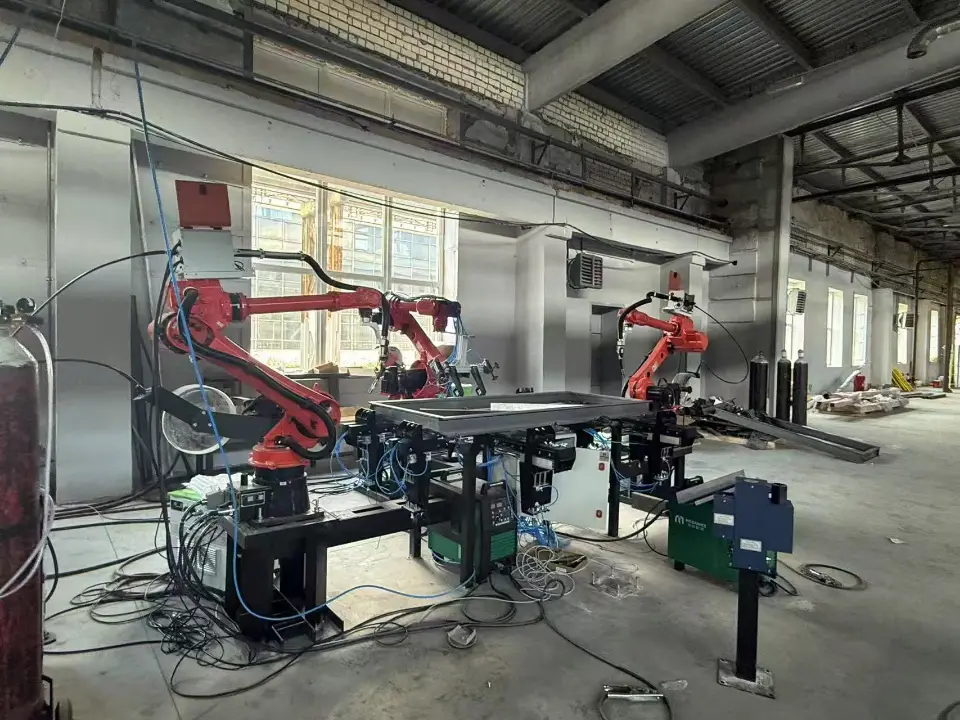
Welding Robots vs Manual Welding — At a Glance
| Feature | Manual Welding | Welding Robots |
|---|---|---|
| Welding Speed | 40–60 cm/min | 60–120 cm/min |
| Operability | Human-limited | 24/7 Continuous |
| Weld Consistency | Medium | High |
| Worker Safety | Higher Risk | Safer Workplace |
| Production Flexibility | Moderate | High (Programmable) |
| Long-Term Efficiency | Limited | High |
| Lifecycle Cost | Variable | Lower at Scale |
Why Manufacturers Are Embracing Welding Robots
At SZGHTECH, we see a clear trend: industrial robots have shifted from “nice to have” to “must-have” across modern manufacturing sectors. Welding robots are now standard for companies pursuing:
✔ Higher quality standards
✔ Stable and predictable output
✔ Competitive pricing and delivery
✔ Lower operational risk
✔ Scalable production strategies
Benefits Across Core Stakeholders
For Engineers:
Predictable, data-backed welding precision
Integratable with vision and inspection systems
Fine-grained control of weld parameters
For Production Managers:
Reduced production cycle times
Fewer production anomalies
Faster onboarding of new parts and products
For Procurement Leaders:
Superior return on investment
Lower total cost of ownership vs labor-intensive solutions
Predictable procurement planning
For Plant Owners & CEOs:
Differentiation through efficiency
Ability to take on complex & high-volume projects
Future-proofing production
For End Customers:
Higher product reliability
Lower defect rates
Better overall value
Why Choose SZGH Welding Robotics Solutions
At SZGHTECH, we deliver industrial welding robot solutions that stand out in:
Performance
Robust motion control, high-speed response, and repeatable accuracy built for industrial scale.
Reliability
Field-proven systems engineered for continuous operation and consistent uptime.
Flexibility
Modular robot arms and adaptive tooling ready for diverse welding tasks.
Scalability
From single-cell automation to fully networked production fleets, our solutions grow with your business.
Expert Support
Deployment guidance, operator training, ROI analysis, and lifetime maintenance support backed directly by SZGH experts.
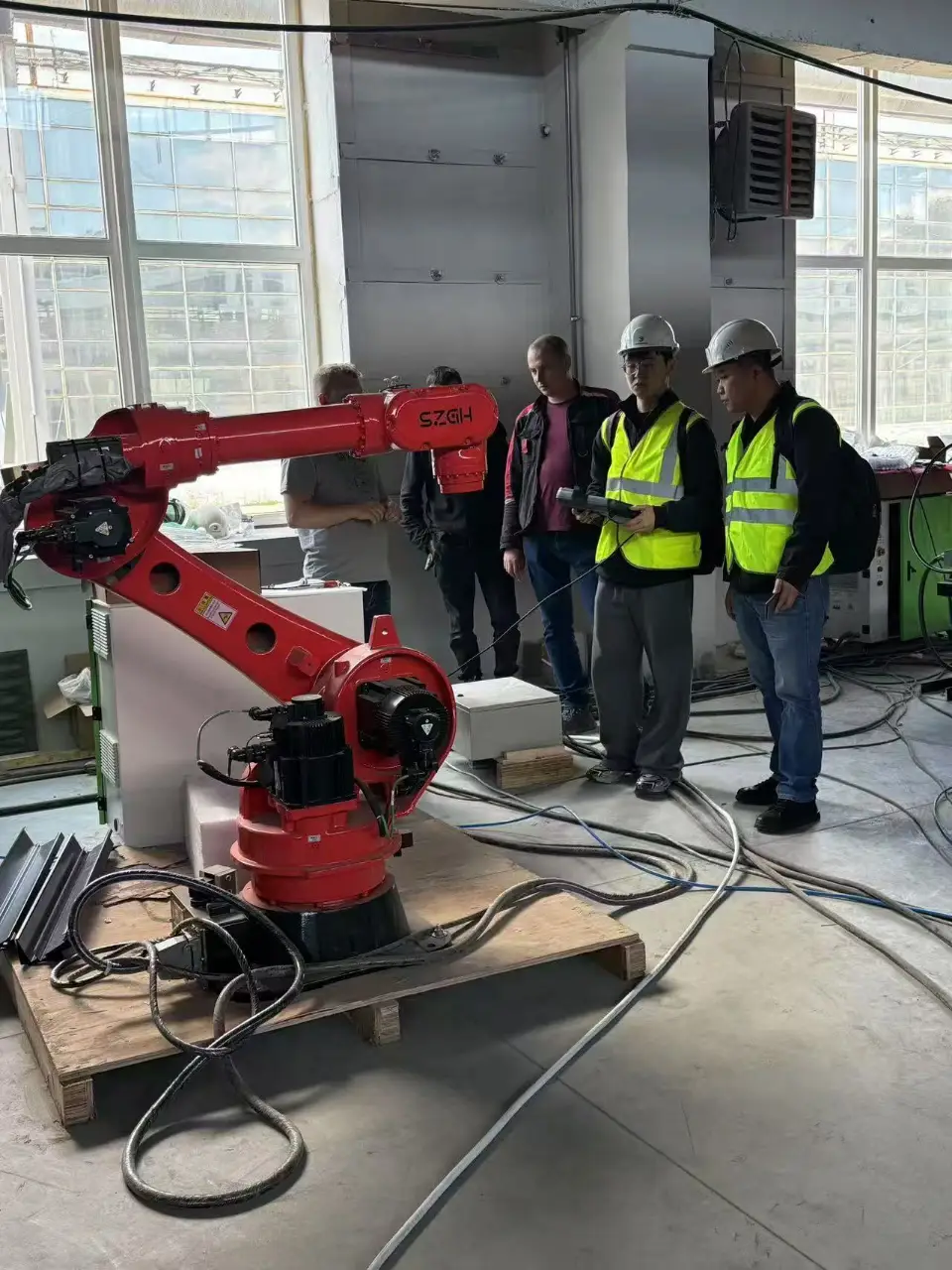
Industrial Robots Are Reshaping Global Manufacturing
Automated welding systems are transforming how factories operate — enabling companies to produce more with higher quality, lower cost, and safer workplaces.
From aerospace and automotive to heavy machinery and industrial equipment, welding automation delivers measurable value across industries.
Ready to Automate Your Welding Process?
If your company is evaluating:
Whether to adopt industrial welding robots
Ways to improve welding quality and throughput
Strategies to outpace competitors
SZGH Tech is here to help.
Visit SZGHTECH.COM to:
✔ Get customized welding robot solutions
✔ Receive application evaluation and ROI analysis
✔ Request pricing, delivery times, and system configuration
✔ Plan deployment and support with our technical team
Let us help you automate your welding — and power your production into the future.